

Klaus Union

Founded in 1946 in Bochum, Germany, today Klaus Union is a market leader for the production and supply of pump systems and valves. Klaus Union keeps numerous patents and offers a comprehensive product portfolio of centrifugal and screw pumps. Since many of the global end users of Klaus Union Pump Systems & Valves are from the chemical, petrochemical, or oil and gas industry, particularly high requirements are placed on all related products.
Pumping or handling aggressive, toxic and/or explosive fluids does not allow any compromise on quality, service life and safety. Klaus Union’s state of the art products guarantee reliable operation and protection of both people and environment.
In the early 1950’s, Klaus Union had already developed the world’s first magnet drive, which was introduced at the ACHEMA in Frankfurt in 1955. Further trendsetting developments followed, such as the first titanium pump manufactured in Europe or state of the are magnet systems.
In 2012, Klaus Union developed Double Volute Twin Screw Pumps with pre-assembled cartridges for quick and easy maintenance. Due to safety and service reasons, today Klaus Union pumping systems are the focus for numerous industries.
A major element if the Klaus Union ethos is to ensure highest product quality. Existing quality assurance procedures with Klaus Union suppliers are constantly monitored from order placement to gods receipt and final assembly. This quality assurance system, developed on latest technologies, complies with the requirements of international regulations. Klaus Union products and processes are certified according to:
- DIN EN ISO 9001
- DIN EN ISO 50001
- Pressure Equipment Directive 2014/68/EU
- Machinery Directive 2006/42/EC
- Explosive Protection Directive 2014/34/EU
(“ATEX Directive”, equipment category 2 for use in explosion protection zone 1, II 2G Ex h IIC T1-T4 Gb)
- EAC Certificate – Certificate of conformity with requirements of technical regulations CU
Klaus Union Magnetic Drive
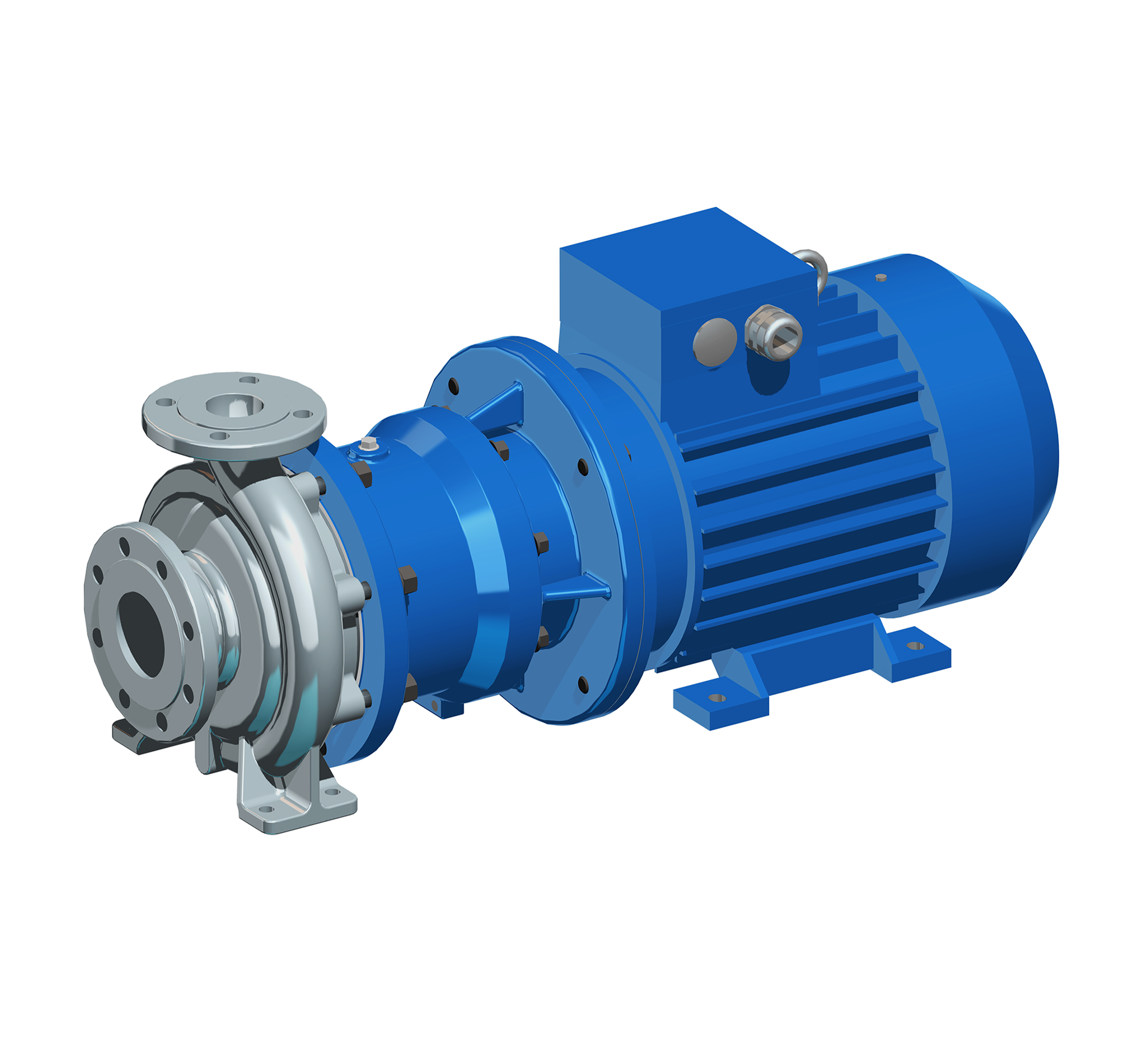
Magnet Drive Centrifugal Pump SLM NVB (Close-Coupled Design)
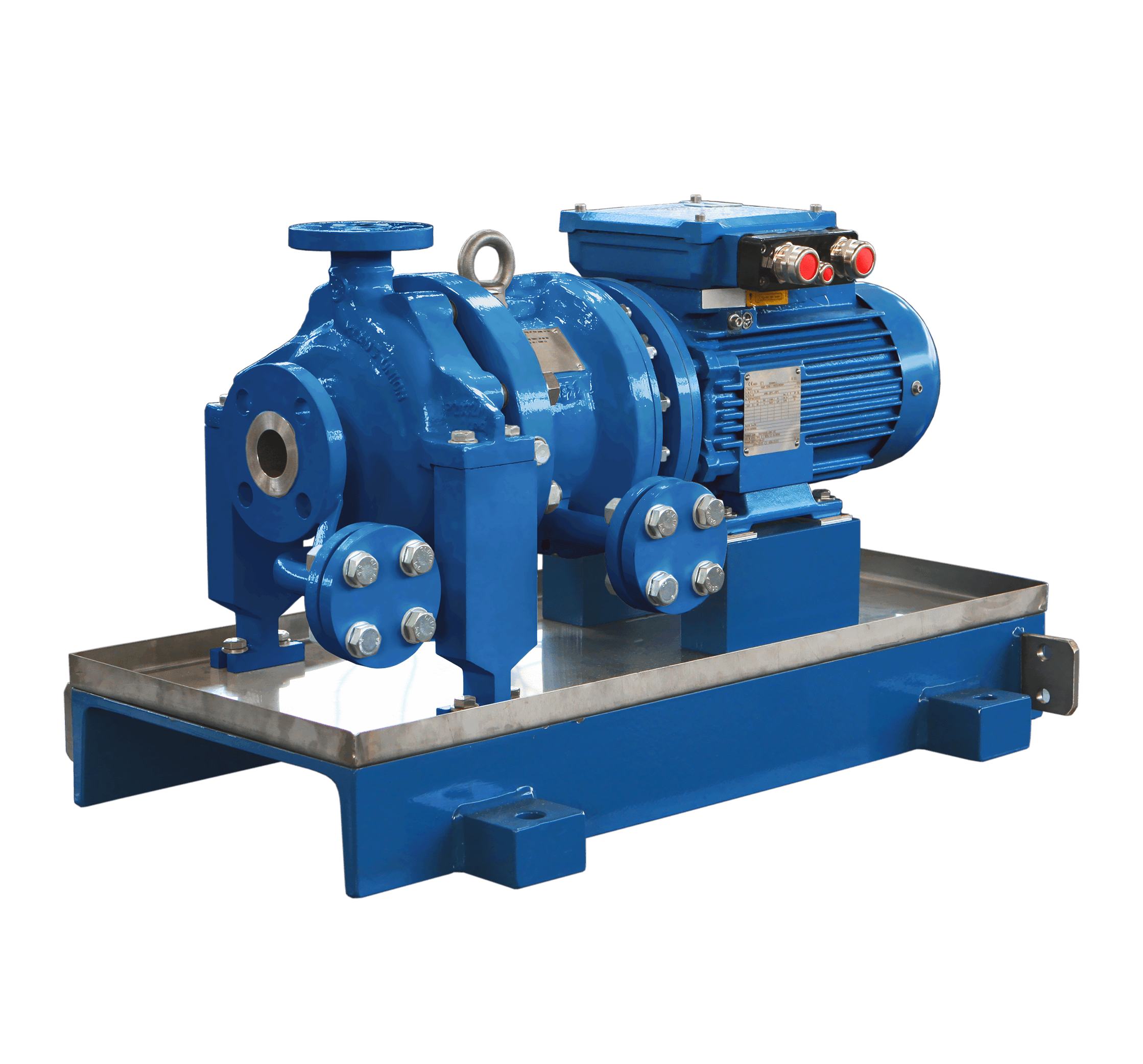
Magnet Drive Centrifugal Pump SLM APC (Close-Coupled Design)
If pumps are used to handle dangerous products, it is essential to avoid even the smallest leakages into the environment in order the ensure the protection of both people and environment. The drive shaft – to transfer the mechanical energy fron the drive to the pump hydraulics – is not a single shaft with a gland packing or mechanical seal on it. Instead, the energy is transferred contactless from the drive shaft to a pump shaft, using a magnetic coupling. The drive shaft connects the motor with the outer magnetic carrier, while the pump shaft holds the inner magnetic carrier and the impeller. Both magnet carriers are fitted with permanent magnets, on the inside and outside respectively.
Due to the rotation of the outer magnet carrier, the inner magnet carrier is rotated syncronously via ,agnetic forces; the mechanical drive energy is transmitted. Between the magnetic carriers, the so-called containment shell is installed to separate the pumped fluid from its environment. The pump shaft is supported by fluid-lubricated maintenance-free slide bearings within the pump’s hydraulic sysem. There are no dynamic seals between the pumped fluid and the environment from which leakage can escape. Only
two static seals are used between pump casing and casing cover and between casing cover and containment shell in the magentic drive pump.
Advantages vs Mechanically Sealed Pumps
- Nearly maintenance free
- Less investment costs and less maintenance costs
- No instrumentation of special monitoring devices required in standard
- No utilities required at all, such as nitrogen or cooling water
- No leakage in the atmosphere at all
- No loss of sealant liquid at all
- No wear of the seals at all
- Low mechanical loads on shafts and bearings
- High stiffness of the pump shaft
Advantages vs Canned Motor Pumps
- Standard IEC and NEMA motors can be used
- Maintenance without disconnecting pump and motor possible
- Lower investment and repair costs
- Separate flushing of journal bearing
- Higher efficiency
- Use of non-metallic containment shell possible
- No heat generation of the rotor by electric losses
- Pumping fluids having higher viscosities possible
- Higher temperatures possible without cooling
- No special monitoring devices necessary